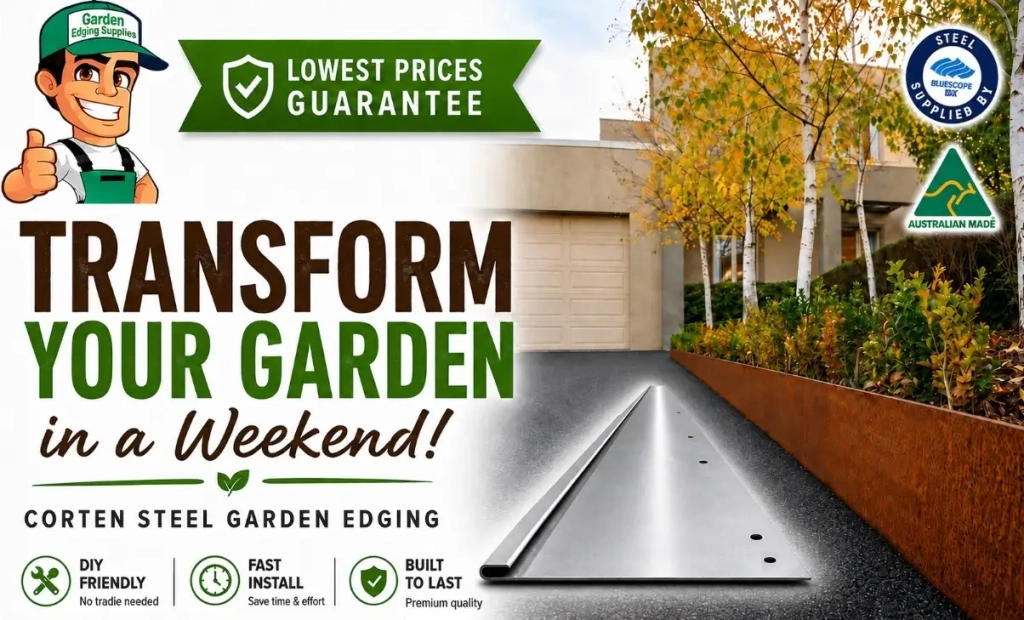
The best type for your garden depends on your desired look, the function of the edging, and your budget. For a natural, rustic appearance that develops a characterful patina, corten steel garden edging is a strong option. If you prefer a clean, silver grey or black finish that stays uniform, galvanised or powder-coated edging is ideal. For heavy duty retaining walls, choose a thicker gauge 2mm or 2.5mm (special order). For curved borders and lawn edges, flexible systems like what we offer work well because they can be bent and formed to almost any shape. Local availability also matters: if you are looking for steel garden edging in Melbourne or the Mornington Peninsula, we offer fast delivery or local pickup.
Why Our Edging Works for Melbourne Gardens
Fast Install, No Special Tools
Our profiles are pre-drilled, so you just hammer in the stakes, slide the edging over them, and screw the connectors in place. There is no need for specialised equipment or a team of installers. A single person can shape a garden bed in an afternoon. This saves you money on labour and lets you get on with planting.
Built for Melbourne’s Climate
Melbourne’s weather swings from hot summers to cold wet winters, and it can be tough on garden edging. Timber rots, plastic goes brittle, and cheap metal bends. Corten steel handles the extremes. It weathers to a warm rusty brown that blends into the landscape, and it does not need painting or sealing. The patina acts as a barrier against further corrosion, so your edging stays strong for decades.
The weak point in any steel edging system is not the steel itself, it is the stakes and the way it is installed. If you use thin stakes or push them into loose soil, the edging can tilt or heave after wet weather. The Redcor kits include properly sized stakes that match the height of the edging, and the pre-drilled holes make it straightforward to fix the strips securely. On the Airtasker listing for a steel garden edging job in Frankston South, the task budget was $100 for installing five or six pieces, which suggests that installation is quick and straightforward for a handyman or a competent DIYer.
Australian-made steel from BlueScope meets strict quality standards and is produced with consistent gauge and coating. Imported steel can be thinner or have poor zinc coverage, which leads to early rust. Given that the product goes in your garden and you want it to last, the small premium for local steel is money well spent.
Steel garden edging in Frankston South is not just another garden trend. When you buy the right product – a proper corten or galvanised kit from a supplier that delivers to your area – you get a border that will outlast the house you are living in. The sceptics who try it usually end up recommending it. If you are still on the fence, order a single kit and see how it looks. Chances are you will be back for more.
A quick trip to Bunnings will show you plastic or thin roll-steel edging for under $30 for a 2m strip. The natural reaction is to wonder why you would spend $212.80 on a 9.6m kit of 100mm-high Redcor edging from Garden Edging Supplies when you can get something that looks similar for a fraction of the price.
The difference is in the thickness, the material, and the system. Bunnings-style thin steel is often around 0.5mm to 1mm thick. It bends under pressure, it can be knocked out of shape by a lawnmower, and it does not hold up to frost or heavy soil movement. Those cheap kits are designed for temporary garden beds, not permanent borders.
The way steel garden edging stops grass runners is simple. It creates a solid, underground barrier that the roots and stolons of grass cannot easily cross. The steel is driven into the ground to a specific depth, forming a wall that runners hit and cannot penetrate. According to Gardening Direct, steel garden edging creates an underground barrier that blocks grass runners from spreading into garden beds and pathways. Both EverEdge and Gardening Direct state that when installed correctly, steel garden edging stops at least 80% of grass runners. That is a very effective rate for a physical barrier. The steel itself is strong and stable once installed. It does not shift easily, so the barrier remains intact over time.
The key to success is the depth. For the barrier to work, the steel must sit below the soil surface by at least 30 to 35 mm. We recommend making sure that around 30 to 35 mm of the steel edging sits below the soil level. EverEdge gives similar advice, suggesting you hammer 30 mm of the edge plus the spikes into the ground to form an underground barrier. This depth is enough to intercept most grass runners, which tend to travel just under the surface. Because the steel does not shift easily, the depth you achieve at installation remains consistent season to season.
What Can Go Wrong And How to Avoid It
Let me tell you about the common stuff I see. First, people try to save money by buying the cheap mild steel edging. A year or two later, it’s rusting unevenly or flaking. Corten steel is the way to go if you want it to last. Second, installing too shallow. I’ve seen edging that’s barely sitting in the ground – it gets knocked out of shape by the first good rain or a dog running through the yard. You need to trench deep enough, at least half the height of the edging buried, and pack the soil back hard.
Third, forgetting to check the council verge rules if you’re edging between your garden and the nature strip. Councils have their own regulations about what you can put on the nature strip. I’m not a council officer, so you’ll want to verify that yourself. But more than once I’ve seen homeowners edge their verge only to get a letter telling them to pull it out. Don’t assume – check first.
Fourth, the rust worry. Corten steel arrives looking silvery grey, and it rusts naturally over a few weeks to months depending on the weather. That rust is meant to happen – it’s the protective layer. But some people panic and try to seal it. Don’t. Let it weather in.